
Written by Vivekananda Hospital Editorial Team | Medically reviewed by Dr Sishir Reddy MD, Department of General Medicine, Vivekananda Hospital, Begumpet
Published: 8 June 2026 | Last reviewed: 8 June 2026 | Figures change daily; see WHO for live data.
Important context for readers in India: As of early June 2026, there are no reported Ebola cases in India, and the risk to the general public in India remains low. This article is for awareness and education. It is not a sign of any local outbreak. For official live updates, always rely on the World Health Organization and India's Ministry of Health and Family Welfare.
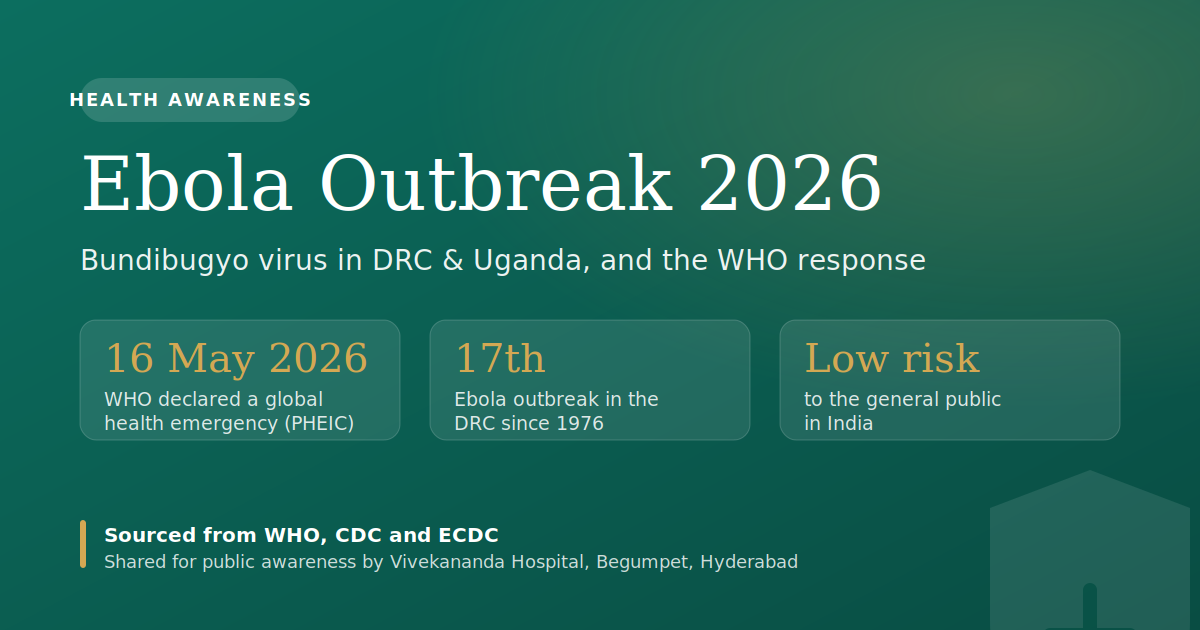
Key Facts at a Glance
- 01 The 2026 outbreak is caused by the Bundibugyo virus, one of the species of ebolavirus. It is the 17th Ebola outbreak recorded in the Democratic Republic of the Congo since 1976.
- 02 WHO declared it a Public Health Emergency of International Concern on 16 May 2026. The Ituri Province in northeastern DRC is the epicentre, with cases also in North Kivu, South Kivu, and Uganda.
- 03 There is currently no licensed vaccine or specific antiviral treatment for the Bundibugyo species, though candidates are being tested. Early supportive care significantly improves survival.
- 04 Ebola spreads through direct contact with the body fluids of an infected person, not through the air. This makes contact tracing and infection control the core of the response.
In This Article
In May 2026, the World Health Organization declared a new Ebola outbreak in the Democratic Republic of the Congo and Uganda a Public Health Emergency of International Concern. The outbreak is caused by the Bundibugyo virus, a species of ebolavirus, and is centred in the Ituri Province of northeastern DRC. This article explains what the outbreak is, how the virus behaves, and the preparedness measures WHO is leading, all drawn from official sources.
What Is Happening in the 2026 Outbreak
On 15 May 2026, the Ministry of Health of the Democratic Republic of the Congo confirmed an Ebola outbreak in Ituri Province. The next day, on 16 May 2026, WHO declared the outbreak a Public Health Emergency of International Concern, the highest level of global health alert. This is the 17th recorded Ebola outbreak in the DRC since the virus was first identified there in 1976, and it began only about five months after the previous outbreak was declared over.
According to figures published by the DRC Ministry of Health and reported by WHO and ECDC in early June 2026, the DRC had recorded several hundred confirmed cases and dozens of related deaths, with Ituri Province the most affected and additional cases in North Kivu and South Kivu. Uganda reported a smaller number of confirmed cases and deaths, including cases linked to travel from the DRC. Because case numbers are updated continuously as laboratory results come in, the exact figures change from day to day.
For current case counts, refer to the WHO Ebola outbreak page and the CDC situation summary, both linked at the end of this article. We do not republish daily figures here because they change faster than any blog can update.
What Ebola Is, and the Bundibugyo Virus
Ebola disease is a severe, often fatal illness caused by a group of viruses known as ebolaviruses, found mainly in sub-Saharan Africa. It belongs to a category called viral haemorrhagic fevers, which in serious cases can affect the body's ability to control bleeding. The disease was first identified in 1976 near the Ebola River in what is now the DRC, which is how it got its name.
There are several species within the ebolavirus group. The species driving the 2026 outbreak is the Bundibugyo virus. This matters for one practical reason: the vaccines and treatments developed and stockpiled in recent years were designed primarily against the Zaire species of Ebola, the one responsible for most large past outbreaks. They are not established as effective against the Bundibugyo species, which is why this outbreak presents a different challenge for responders.
Ebola is a rare disease. Historically, it has had a high case fatality rate, but outcomes improve substantially when patients receive supportive medical care early. Survival is possible, and recoveries have already been reported in this outbreak among people who reached treatment centres quickly.
How Ebola Spreads
Ebola does not spread through the air like the flu or COVID-19. A person becomes infected only through direct contact. Understanding this is the key to understanding both the risk and the response.
Contact with body fluids. The virus spreads through direct contact with the blood, vomit, faeces, saliva, sweat, urine, breast milk, or semen of a person who is sick with or has died from Ebola.
Contaminated surfaces and objects. Touching surfaces, bedding, clothing, or medical equipment soiled with the body fluids of an infected person can transmit the virus.
Burial practices. Traditional funeral rituals that involve direct contact with the body of someone who died of Ebola are a known source of transmission, which is why safe and dignified burial is part of the response.
Infected animals. The virus can pass to people from infected wild animals such as fruit bats or primates, often through handling or eating bushmeat.
A person with Ebola is not contagious until they develop symptoms. Because spread requires close contact with fluids, healthcare workers and family caregivers are among those at highest risk, and rigorous infection prevention is the central protective measure.
Symptoms and Incubation Period
Symptoms can appear anywhere from 2 to 21 days after exposure, with 8 to 10 days being most common. This 21-day window is why people who may have been exposed are monitored for three weeks. Early symptoms resemble many common illnesses, which makes laboratory testing essential for diagnosis.
Early symptoms
- Sudden fever
- Severe fatigue and weakness
- Muscle and joint pain
- Headache
- Sore throat
Later symptoms
- Vomiting and diarrhoea
- Skin rash
- Impaired kidney and liver function
- Internal and external bleeding in some cases
WHO Preparedness and Response
WHO is supporting the governments of the DRC and Uganda across several coordinated areas. The response is built on a set of well-established pillars used to bring Ebola outbreaks under control. These are the main components.
Surveillance and case finding
Active searching for new cases and rapid reporting so that infected people are identified and isolated quickly. This includes screening at health facilities and in communities.
Contact tracing
Identifying everyone who has been in contact with a confirmed case and monitoring them through the 21-day incubation window, so that any new illness is caught and isolated before it spreads further.
Clinical care and treatment centres
Setting up dedicated Ebola treatment centres with isolation capacity. WHO reported treatment facilities operating in Bunia and several other towns across the affected region, with more being added. Early supportive care raises the chance of survival.
Laboratory and diagnostic capacity
Decentralising testing to locations closer to where cases occur, to reduce delays in confirming or ruling out suspected cases and to speed up response decisions.
Community engagement
Working with community and faith leaders, women's groups, and traditional healers. WHO has repeatedly stressed that outbreaks are only brought under control when communities are actively engaged in the response, including in safe burial practices.
Cross-border preparedness
Coordinating between the DRC, Uganda, and neighbouring countries, along with supply delivery and screening at borders and points of entry, given the high movement of people and trade in the region.
Is There a Vaccine or Treatment
For the Bundibugyo species causing this outbreak, there is currently no licensed vaccine and no specific approved antiviral treatment. This is an important difference from recent outbreaks of the Zaire species, where a licensed vaccine and antibody treatments were available. Researchers are working to test promising candidates against the Bundibugyo virus.
In the absence of a specific cure, the foundation of care is supportive treatment: maintaining fluids and electrolytes, supporting blood pressure and oxygen, and treating other infections if they appear. This kind of care, delivered early, is what improves survival, which is why reaching a treatment centre at the first sign of symptoms is so important for anyone in an affected area.
What It Means for India and Hyderabad
As of early June 2026, there are no reported Ebola cases in India. The outbreak is concentrated in Central and East Africa, and the risk to the general public in India is low. Because Ebola spreads only through direct contact with body fluids, and not through the air, it does not move between countries the way respiratory viruses do. The realistic route of entry to any distant country is an individual traveller who was exposed in an affected region.
For that reason, the sensible precautions are simple. If you or someone you know has travelled from an affected country within the last 21 days and develops a sudden fever or the symptoms described above, do not ignore it and do not self-medicate. Inform a hospital by phone before arriving so that staff can guide you safely, and mention the travel history clearly. For the overwhelming majority of people in Hyderabad with no such travel link, there is no cause for worry.
Avoid panic and avoid forwarding unverified messages. During past outbreaks, misinformation spread faster than the virus itself. Rely only on official sources: the World Health Organization, and in India, the Ministry of Health and Family Welfare and the National Centre for Disease Control.
How to Protect Yourself
These measures matter most for people in or travelling to affected regions, and for healthcare workers. For the general public in India, they are good general hygiene practice.
Wash hands often with soap and water or an alcohol-based sanitiser.
Avoid contact with the blood or body fluids of anyone who is sick.
Do not handle items that may have touched an infected person's fluids.
Avoid contact with wild animals and do not handle or eat bushmeat in affected regions.
Seek care early and call ahead if you have symptoms with a relevant travel history.
Follow official guidance from WHO and national health authorities, not social media rumours.
Frequently Asked Questions
Official Sources for Live Updates
World Health Organization, Ebola outbreak DRC 2026: who.int
US CDC, Ebola situation summary: cdc.gov/ebola
ECDC, Ebola outbreak updates: ecdc.europa.eu
India, Ministry of Health and Family Welfare: mohfw.gov.in
About this article: Vivekananda Hospital shares this information in the interest of public health awareness for our community. The figures and details are drawn from the World Health Organization, the US Centers for Disease Control and Prevention, and the European Centre for Disease Prevention and Control, as available in early June 2026. Outbreak figures change daily; please refer to the official sources above for the latest data.
Medical disclaimer: This article is for general information and education only. It is not medical advice, diagnosis, or treatment. If you have symptoms with a relevant travel history, call a hospital before arriving and mention your travel clearly. In an emergency, contact your nearest hospital or Vivekananda Hospital on +91 7207904418.
If our content helps you, tell Google to show you more of it. Add vivekanandahospital.in as a preferred source.