
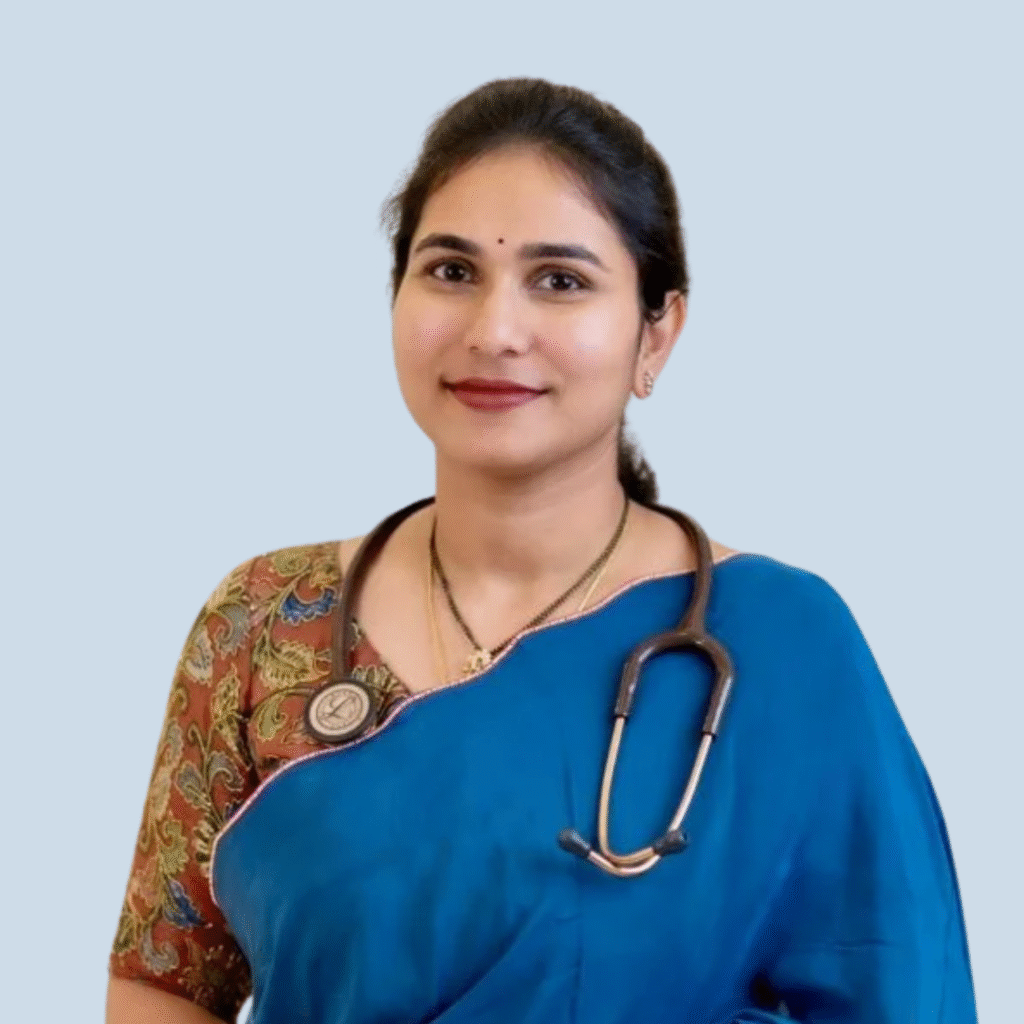
Visiting Consultant Neurologist. Dr. Manvitha Reddy consults at Vivekananda Hospital by appointment for non-emergency neurological cases. She is on call 24 hours for acute stroke thrombolysis under the Time-is-Brain protocol.
Sudden weakness, slurred speech, facial droop or severe sudden headache may be a stroke. Dr. Manvitha is on 24-hour call for thrombolysis (clot-busting injection) within the 4.5-hour treatment window. Call +91 72079 04418 immediately or come directly to the Vivekananda Hospital emergency department.
By appointment
24-hour on call for acute stroke thrombolysis emergenciesNeurologist with stroke specialisation and rare therapeutic procedure expertise
Dr. G. Manvitha Reddy is a Visiting Consultant Neurologist at Vivekananda Hospital, Begumpet, with credentials that span academic distinction and procedural sub-specialty. She holds an MBBS, MD in Internal Medicine where she was a Gold Medalist and ranked 5th in the KNRUHS university examinations, and a DrNB in Neurology from CARE Hospitals, Banjara Hills, one of the few Hyderabad neurology training programmes that combines tertiary stroke care with movement disorder and epilepsy sub-specialty rotations.
Her primary clinical focus at Vivekananda Hospital is acute stroke management through thrombolysis. The 4.5-hour window after stroke onset is the most important variable in long-term recovery. A patient who receives clot-busting treatment within this window has dramatically better outcomes than one who arrives too late. She is on 24-hour call to attend Vivekananda Hospital emergency cases requiring urgent neurological assessment and thrombolysis decision, with the hospital ICU and CT imaging available continuously.
On the procedural side, she performs therapeutic Botulinum toxin injections for conditions where most general neurologists in Hyderabad refer out. These include hemifacial spasm, blepharospasm, post-stroke spasticity, dystonia, and chronic migraine. The procedure involves precise injection of small Botulinum toxin doses into specific muscles, and benefit lasts 3 to 4 months per session. She also performs Median Nerve Hydro Dissection for carpal tunnel syndrome, a non-surgical alternative for patients who are not yet candidates for open surgery.
She investigates neurological symptoms using EEG (for seizures), ENMG or Electroneuromyography (for nerve and muscle disorders), and lumbar puncture (for meningitis, autoimmune neurological disease, and other CSF-related diagnoses). Her approach is analytical: she interprets MRI and CT scans personally rather than relying solely on radiology reports, on the basis that the treating neurologist often catches subtle findings the imaging report misses.
Her academic engagement is current and active. She is among the Top 15 nationwide in the EEG examination conducted by NESSAN in 2023, has won first prizes at quiz competitions on Multiple Sclerosis (NIMS) and EEG (KIMS), and has presented award-winning research papers on Post-Stroke Epilepsy and Parkinson's Disease. This continuous academic involvement reflects ongoing exposure to current neurological practice rather than reliance on training that may have been completed years ago.
In neurology, time is brain. Whether it is a stroke or a complex movement disorder, my focus is on rapid, analytical diagnosis to protect the nervous system and restore function.
Education and Training
- MBBS
- MD Internal Medicine, Gold Medalist, 5th Rank KNRUHS University
- DrNB Neurology, CARE Hospitals, Banjara Hills
Awards and Recognition
- Top 15 Nationwide, EEG Examination by NESSAN, 2023
- 1st Prize, Multiple Sclerosis Update Quiz, NIMS
- 1st Prize, EEG Quiz, KIMS Hospitals
- 3rd Prize, National MDSCON 2025 Neurology Quiz, Varanasi
- Award-winning research papers on Post-Stroke Epilepsy and Parkinson's Disease
What Dr. Manvitha treats at Vivekananda Hospital
Comprehensive neurology including emergency stroke care, therapeutic injection procedures, and diagnostic neurophysiology. Most conditions are managed medically with surgery referred only where genuinely required.
Stroke and Emergency
- Acute stroke thrombolysis (24/7)
- TIA (mini-stroke) evaluation
- Post-stroke rehabilitation planning
- Stroke prevention assessment
- Carotid disease evaluation
Therapeutic Botox
- Hemifacial spasm
- Blepharospasm (eye twitching)
- Post-stroke spasticity
- Cervical dystonia and other dystonias
- Chronic migraine
- Hyperhidrosis (excessive sweating)
Epilepsy and Seizures
- New-onset seizure evaluation
- Drug-refractory epilepsy management
- EEG interpretation
- Seizure medication optimisation
- Pregnancy in epilepsy counselling
Movement Disorders
- Parkinson's disease diagnosis and management
- Essential tremor
- Tremor differential diagnosis (UPDRS, Fahn-Tolosa-Marin)
- Dystonia evaluation and treatment
- Tic disorders
Headache and Migraine
- Chronic migraine evaluation
- Tension-type headache
- Cluster headache
- Nerve blocks for refractory headache
- Preventive medication titration
Nerve and Muscle
- ENMG (Electroneuromyography)
- Carpal tunnel syndrome (incl. hydro dissection)
- Peripheral neuropathy
- Guillain-Barre syndrome
- Myasthenia gravis
- Multiple sclerosis
- F Face drooping on one side
- A Arm weakness on one side
- S Speech slurred or difficult
- T Time to call emergency services and bring the patient to hospital
- Other warning signs: sudden severe headache, sudden vision loss, sudden loss of balance, sudden numbness
Stroke treatment works best within 4.5 hours of symptom onset. The earlier the patient reaches the hospital, the more brain tissue can be saved. Call +91 72079 04418 or come directly to the Vivekananda Hospital emergency department.
Patient QuestionsFrequently asked questions
How is Dr. Manvitha available for stroke emergencies?
What is thrombolysis and why is the 4.5-hour window important?
What are her qualifications?
Can Botox be used for medical conditions other than cosmetic use?
I have seizures that are not controlled with medication. Can she help?
What is the difference between a tremor and Parkinson's Disease?
Is a Lumbar Puncture (Spinal Tap) safe?
I have carpal tunnel syndrome. Do I need surgery?
Do you treat severe migraines that have not responded to medication?
What should I bring for my first consultation?
How do I book an appointment?
Book a consultation with Dr. G. Manvitha Reddy
Non-emergency consultations by appointment. 24-hour on call for acute stroke thrombolysis.