
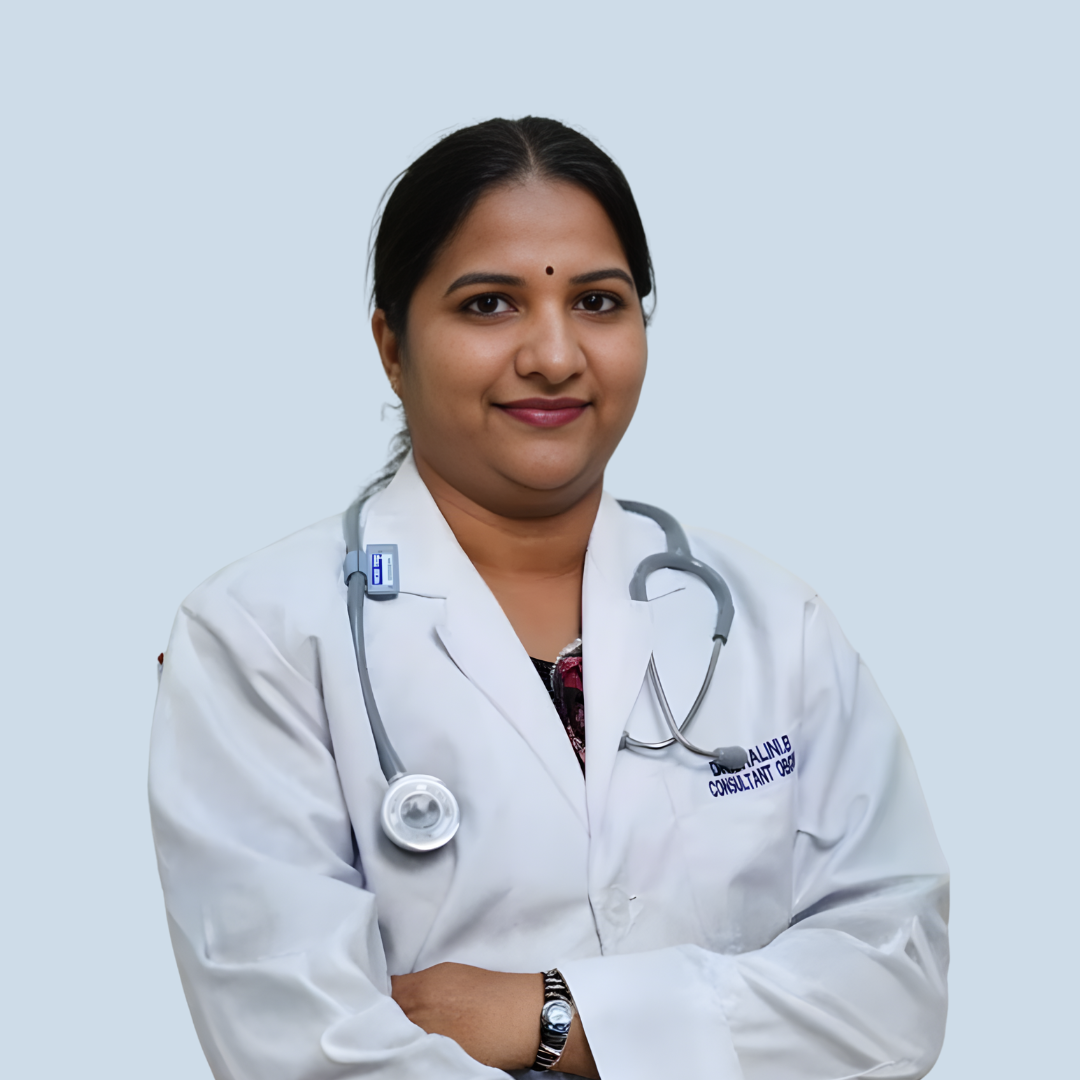
Written by Vivekananda Hospital Editorial Team | Medically reviewed by Dr. Shalini B (MBBS Gold Medal, DGO, DNB OB-GYN, FMAS)
Senior Consultant OB-GYN, Vivekananda Hospital, Begumpet | Last reviewed: 8 June 2026
When to Go to Hospital Immediately
If you are pregnant with fever and ANY of these warning signs, do not wait at home. Call us on +91 7207904418 and come in:
Severe abdominal pain, persistent vomiting, bleeding from gums or nose, blood in vomit or stool, black stools, difficulty breathing, extreme tiredness or restlessness, reduced baby movements, or any vaginal bleeding. Never take aspirin or ibuprofen for the fever.
If you have children at home, also read our guide on dengue fever in children, including the warning signs every parent should watch for.
Key Takeaways
- 01 Dengue in pregnancy needs closer monitoring than dengue in other adults, because of added risks of bleeding, low platelets, preterm birth, and low birth weight.
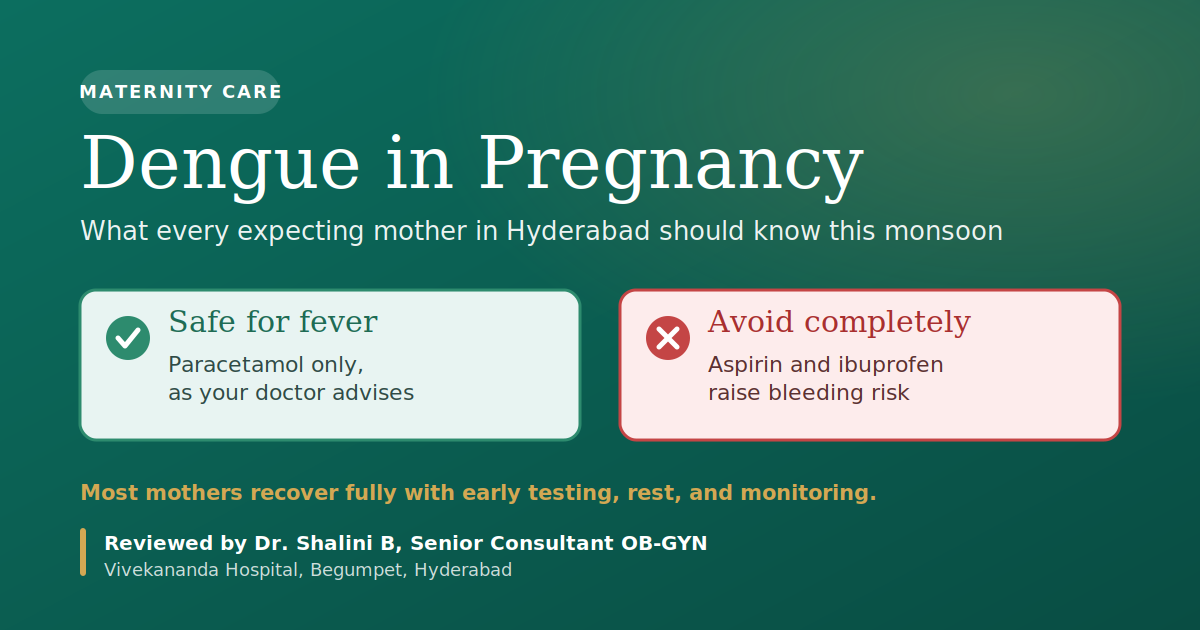
- 02 For fever, only paracetamol is safe. Aspirin, ibuprofen, and other NSAIDs must be avoided as they increase bleeding risk.
- 03 Dengue close to your due date is the most dangerous timing, because low platelets at delivery raise the risk of heavy bleeding. Delivery should be in a hospital with a blood bank.
- 04 Most pregnant women with dengue recover fully with early diagnosis, rest, fluids, and platelet monitoring. The danger comes from delay, not from the infection alone.
In This Article
Dengue in pregnancy is a mosquito-borne viral infection that needs careful medical monitoring because it can raise the risk of bleeding, low platelet counts, preterm birth, and low birth weight. It is not a reason to panic. With early diagnosis, rest, careful fluid management, and platelet monitoring, most pregnant women recover fully and deliver healthy babies. The danger lies in delay and in self-medication, not in the infection by itself.
Hyderabad sees a sharp rise in dengue every monsoon. For an expecting mother, a high fever during these months is naturally worrying. This guide explains exactly what dengue does in pregnancy, what is genuinely dangerous, and what good care looks like, so you can act early and calmly.
"Every monsoon I see pregnant women who waited two or three days at home with fever, taking the wrong painkillers, before coming in. Dengue in pregnancy is very manageable when we catch it early. What makes it dangerous is delay and self-medication with aspirin or ibuprofen. If you are pregnant and have a fever during monsoon, get tested. Do not wait."
Dr. Shalini B, Senior Consultant OB-GYN, Vivekananda Hospital Begumpet
How Dengue Affects Pregnancy: Risks to Mother and Baby
Pregnancy changes how the body responds to dengue. The infection lowers platelet counts and makes small blood vessels leak fluid, and pregnancy already places extra demand on the circulatory system. This combination is why pregnant women need closer monitoring than other adults with dengue. The risks fall into two groups.
Risks to the mother
- Low platelet count (thrombocytopenia)
- Bleeding, including postpartum haemorrhage
- Higher chance of caesarean delivery
- Anaemia and dehydration
- In severe cases, plasma leakage and shock
Risks to the baby
- Preterm (early) birth
- Low birth weight
- Fetal distress during labour
- Rarely, transmission to the baby around delivery
- Premature rupture of membranes
It is important to keep perspective. These are possible risks, not certainties. Most dengue infections in pregnancy are mild to moderate and resolve with supportive care. A high-risk pregnancy team manages the small proportion of cases that become serious.
Does the Trimester Matter?
Yes, timing changes the main concern. Research on dengue in pregnancy is still developing and findings vary, but the broad pattern your doctor watches for is this.
Symptoms and Warning Signs in Pregnancy
Dengue symptoms usually start 4 to 10 days after an infected mosquito bite. The early symptoms are the same in pregnant and non-pregnant people, but in pregnancy any of them deserves prompt testing rather than waiting it out.
Common symptoms
- Sudden high fever
- Severe headache and pain behind the eyes
- Muscle, bone, and joint pain
- Nausea and vomiting
- Skin rash
- Tiredness
Warning signs (go to hospital)
- Severe abdominal pain
- Persistent vomiting
- Bleeding gums or nose
- Blood in vomit or stool
- Difficulty breathing
- Reduced baby movements or any vaginal bleeding
How Dengue Is Diagnosed
Dengue is confirmed with a simple blood test. In the first few days of fever, the NS1 antigen test is used. From around day five, IgM and IgG antibody tests become useful. Alongside this, your doctor will order a complete blood count to track your platelet count and haematocrit, which are the two numbers that matter most in pregnancy.
Platelet counts are usually repeated daily, sometimes twice a day if they are falling, so that any drop is caught early. Fetal wellbeing is checked with ultrasound and, in later pregnancy, fetal monitoring.
Safe Treatment and Medicines to Avoid
There is no specific antiviral drug for dengue. Treatment is supportive, which means managing fever, keeping you well hydrated, and watching platelets and fetal wellbeing closely. The single most important safety point in pregnancy is which medicine you use for the fever.
Safe in pregnancy
Paracetamol (acetaminophen) for fever and pain, in the dose your doctor advises. Plenty of oral fluids. Rest. Hospital admission and IV fluids if warning signs appear or platelets fall sharply. Platelet transfusion only if clinically needed.
Avoid completely
Aspirin, ibuprofen, and other NSAID painkillers. They increase the risk of bleeding, which is already a concern in dengue, and some are unsafe in pregnancy. Never self-medicate. Do not take any painkiller for dengue fever without your doctor confirming it.
Whether you are treated at home with daily monitoring or admitted depends on your platelet trend, your symptoms, and how far along you are. Your obstetrician and physician work together on this decision.
Dengue Near Your Delivery Date
This is the situation that needs the most care. If dengue strikes in the final weeks, your platelet count may be low exactly when your body needs to clot well for delivery. Low platelets at the time of birth raise the risk of heavy bleeding, whether the delivery is normal or caesarean.
For this reason, a mother with dengue near term should deliver in a hospital that has a blood bank, platelet access, a 24-hour operation theatre, and a NICU for the baby. At Vivekananda Hospital, dengue in late pregnancy is managed jointly by the obstetric and general medicine teams, with delivery timing planned around your platelet recovery wherever it is safe to wait. If you are weighing your options, our guide on how a doctor decides between normal delivery and C-section explains how infection affects that decision.
Monsoon Prevention for Hyderabad Mothers
The Aedes mosquito that spreads dengue breeds in clean, standing water and bites mostly in the early morning and late afternoon. Prevention is simple and entirely in your hands. It matters most from June through October when Hyderabad sees the most cases.
Empty standing water weekly from flower pots, coolers, buckets, and old containers around your home.
Use mosquito repellent safe for pregnancy on exposed skin, and ask your doctor which to use.
Wear long sleeves and full-length clothing, especially in the morning and evening.
Use mosquito nets while sleeping and screens on windows and doors.
Keep surroundings clean and ensure water tanks and drains are covered.
Test fever early. Any fever in pregnancy during monsoon should be checked, not waited out.
Plan your pregnancy dates with our free tool:
Pregnancy due date calculatorFrequently Asked Questions
About the Medical Reviewer
Dr. Shalini B (MBBS Gold Medal, DGO Osmania Medical College, DNB OB-GYN, Fellowship in Minimal Access Surgery) is Senior Consultant Obstetrician and Gynaecologist at Vivekananda Hospital, Begumpet, Hyderabad, with over 5,000 deliveries and extensive experience managing fever and infections in pregnancy. NMC registration verifiable on the Indian Medical Register.
Medical disclaimer: This article is for general health information and education only. It is not a substitute for professional medical advice, diagnosis, or treatment. Dengue in pregnancy needs individual assessment by a qualified doctor. If you are pregnant with fever or any warning sign, contact your doctor or call +91 7207904418 immediately.
References: WHO Dengue and severe dengue fact sheet | National Center for Vector Borne Diseases Control (NCVBDC), India | Peer-reviewed reviews on maternal and perinatal outcomes of dengue in pregnancy (NCBI/PMC).
If our content helps you, tell Google to show you more of it. Add vivekanandahospital.in as a preferred source.