
Dengue Platelet Count: Normal Range and When to Worry
A normal platelet count is 1.5 to 4.5 lakh (150,000 to 450,000). In dengue the count falls, usually reaching its lowest between day 4 and 7, then recovers on its own as you get better. The most important thing to understand: the number alone does not decide danger or treatment. The trend and the warning signs matter more. A platelet transfusion is only for very low counts with bleeding, not for a low number by itself. Monitor, stay hydrated, and watch for warning signs.
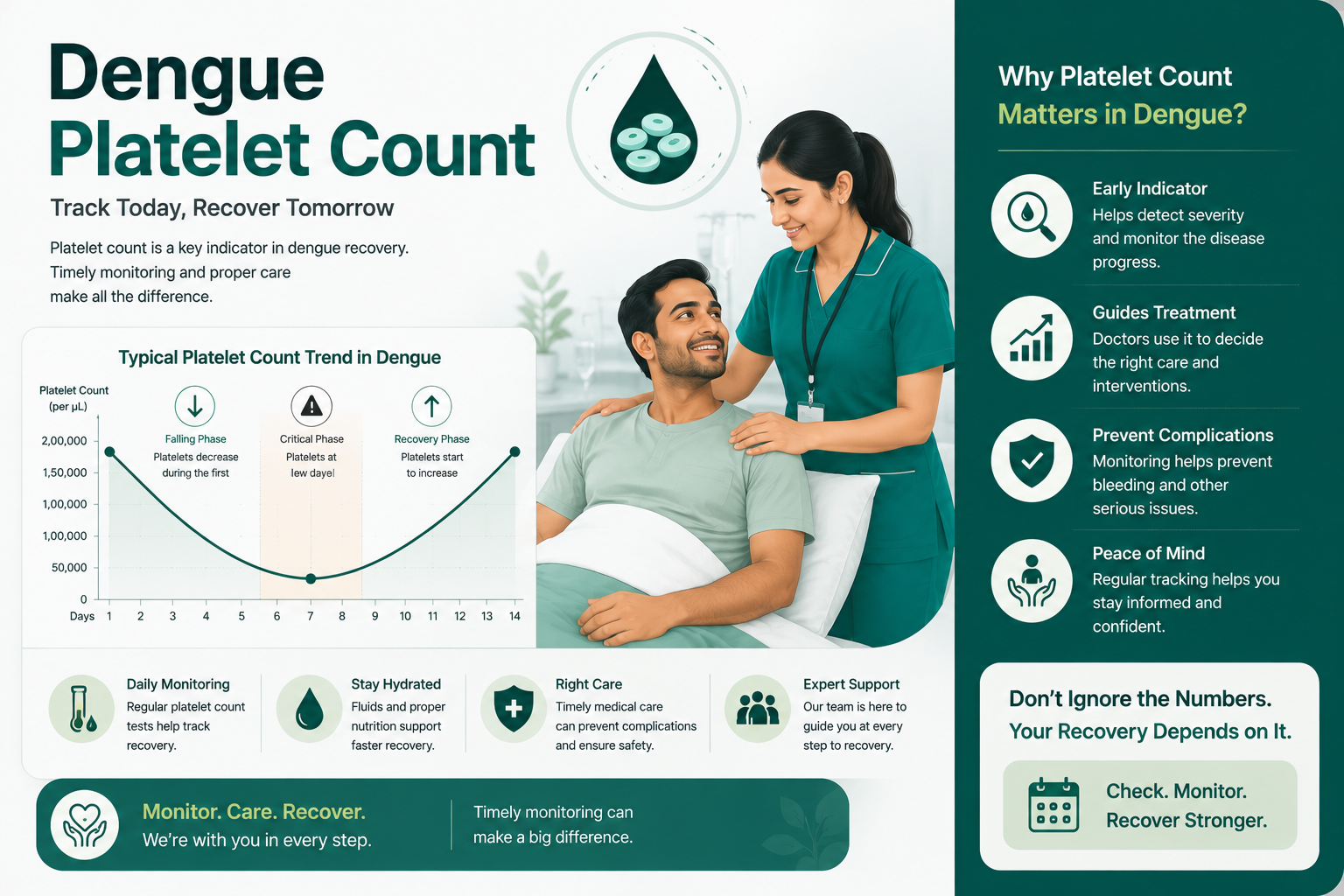
A falling platelet count is the thing that frightens families most in dengue, and it is also the most misunderstood. This guide gives the normal range, why platelets drop, a clear chart of what different counts usually mean, when a hospital is needed, and the truth about transfusions. It is general information, not a diagnosis, and your doctor decides based on your full picture.
What Is a Normal Platelet Count?
A normal platelet count is between 1.5 lakh and 4.5 lakh per microlitre, written as 150,000 to 450,000. Platelets are the cells that help blood clot. In dengue, the count typically starts to fall from around day 3 or 4 of the illness, which is why doctors repeat the platelet count daily during this window.
Why Platelets Fall in Dengue
The dengue virus temporarily reduces the body's production of platelets in the bone marrow and increases their breakdown. This is usually temporary.
As the infection is cleared during the recovery phase, the bone marrow returns to normal and the platelet count climbs back up, most often without any specific treatment.
Dengue Platelet Count Day by Day
Platelets follow a fairly predictable curve through the illness. This is a general pattern, not a fixed rule, and the exact days shift from person to person, but it helps you know what to expect and when to test.
| Day of illness | What usually happens to platelets |
|---|---|
| Day 1 to 2 | Often still normal or only slightly reduced, even with high fever |
| Day 3 to 4 | Count begins to fall; daily testing usually starts here |
| Day 4 to 7 | Lowest point, the nadir, and the critical phase; monitor most closely now |
| Day 7 to 8 | Count starts to turn upward as the recovery phase begins |
| Day 8 to 10 | Steady rise back toward normal in most people |
The takeaway is timing: a normal platelet count on day 2 does not rule dengue out, and the days to watch hardest are 4 to 7, often just when the fever is settling and people feel they are improving.
Dengue Platelet Count Chart: When to Worry
Use this as a general guide, not a rulebook. The single most important message is underneath the table.
| Platelet count | What it usually means | Typical approach |
|---|---|---|
| Above 1.5 lakh | Normal | Routine, repeat if symptoms continue |
| 1 to 1.5 lakh | Mildly low | Monitor, repeat the test |
| 50,000 to 1 lakh | Low | Closer monitoring, often manageable as outpatient if you feel well |
| 20,000 to 50,000 | Significantly low | Usually hospital monitoring |
| Below 20,000 | High bleeding risk | Hospital; transfusion if there is bleeding |
When Is a Platelet Transfusion Actually Needed?
This is the biggest misconception in dengue. A platelet transfusion is not given just because the number looks low. Most people recover their platelets on their own without any transfusion.
Transfusion is reserved for two situations: a very low count, usually under 10,000 to 20,000, or active bleeding. Giving platelets unnecessarily carries its own risks and does not speed recovery.
So if a count of 50,000 is quoted and someone panics and demands a transfusion, that is the wrong instinct. Monitoring is the right one.
When Do Platelets Recover?
Platelets usually reach their lowest around day 4 to 7, then begin to rise as the fever settles and the recovery phase starts. From that turning point they often return to normal within about a week. A rising count is one of the clearest signs you are through the worst, but keep testing until it is clearly and steadily recovering.
What Platelet Count Is Safe to Go Home?
There is no single fixed number that means safe to discharge, because recovery is judged on the trend, not one reading.
In practice, a person is usually considered ready to go home when the platelet count is clearly and steadily rising over repeated tests rather than still falling, when there has been no bleeding and no warning sign for at least a day, when they are eating, drinking and passing urine normally, and when the fever has settled.
Many doctors are reassured once the platelet count is rising and back above roughly 50,000. But a rising 40,000 with everything else normal can be safer than a falling 70,000. Your treating doctor makes this call on the full picture, so do not push for early discharge on a single good number alone.
How to Help Platelets Recover
There is no food, drink or tablet that raises platelets dramatically overnight. What helps is supporting your body while it recovers on its own: rest, plenty of fluids, and good nutrition.
Papaya leaf extract is widely used and a few small studies suggest a modest effect, but it is not a substitute for monitoring and medical care, and it should never delay getting checked. For a practical eating plan, see our guide to a dengue diet and foods to support platelet recovery.
When to Get to Hospital
The platelet count is only part of the picture. Get medical care straight away if you have any warning signs, whatever the number.
Go to hospital immediately if you have
- Bleeding from the gums or nose, blood in vomit, urine or stool, or red spots under the skin
- A rapidly falling platelet count on repeated tests
- Severe abdominal pain, persistent vomiting, or you cannot keep fluids down
- Breathlessness, restlessness, drowsiness, cold clammy skin, or very little urine
Call +91 7207904418. See dengue fever treatment in Hyderabad.
Platelets dropping? Get monitored properly.
A falling count needs the right monitoring, not panic. Consult Dr. Ravi Sishir Reddy at Vivekananda Hospital, Begumpet, with an in-house lab for fast platelet reports and 24/7 care if admission is needed.
Frequently Asked Questions
What is a normal platelet count?
A normal platelet count is between 1.5 lakh and 4.5 lakh per microlitre, that is 150,000 to 450,000. In dengue the count usually starts to fall from around day 3 or 4, reaches its lowest between day 4 and 7, and then recovers as you get better.
At what platelet count is dengue dangerous?
There is no single magic number. Risk rises as the count falls below 50,000, and bleeding risk becomes significant below 20,000. But the count alone does not decide danger. A rapid fall, warning signs, and how you feel matter more than the exact figure. A steady count of 40,000 without bleeding can be safer than a fast-dropping 60,000 with warning signs.
When is hospital admission needed for low platelets in dengue?
Admission is guided by warning signs and the trend, not just the number. A very low or rapidly falling count, any bleeding, severe abdominal pain, persistent vomiting or poor fluid intake are reasons to be admitted for monitoring. A stable, mildly low count in someone who is eating, drinking and feeling well can often be watched with regular blood tests.
Does a low platelet count always need a transfusion?
No, and this matters. A platelet transfusion is not given for a low number by itself. It is reserved for very low counts, usually under 10,000 to 20,000, or for active bleeding. Most people's platelets recover on their own without any transfusion. Asking for a transfusion just because the number looks low is not the right approach.
How can I increase platelets in dengue?
Platelets recover on their own as the infection settles, helped by rest, plenty of fluids and good nutrition. No food or supplement raises them dramatically overnight. Papaya leaf extract is popularly used and some small studies suggest a modest effect, but it is not a substitute for monitoring and medical care.
When do platelets recover in dengue?
Platelets usually reach their lowest around day 4 to 7 and then begin to rise as the fever settles and the recovery phase starts, often returning to normal within about a week of that turning point. A rising count is a reassuring sign, but keep monitoring until it is clearly and steadily recovering.
Reviewed by Dr. Ravi Sishir Reddy, MD (General Medicine), Vivekananda Hospital, Begumpet. Last updated 12 Aug 2026. For general information only and not a substitute for medical advice or diagnosis. Treatment decisions depend on your full clinical picture, not a single platelet reading. Not for medical emergencies; for urgent help call +91 7207904418.
If our content helps you, tell Google to show you more of it. Add vivekanandahospital.in as a preferred source.