
Internal and External Piles: Types, Grades and Treatment
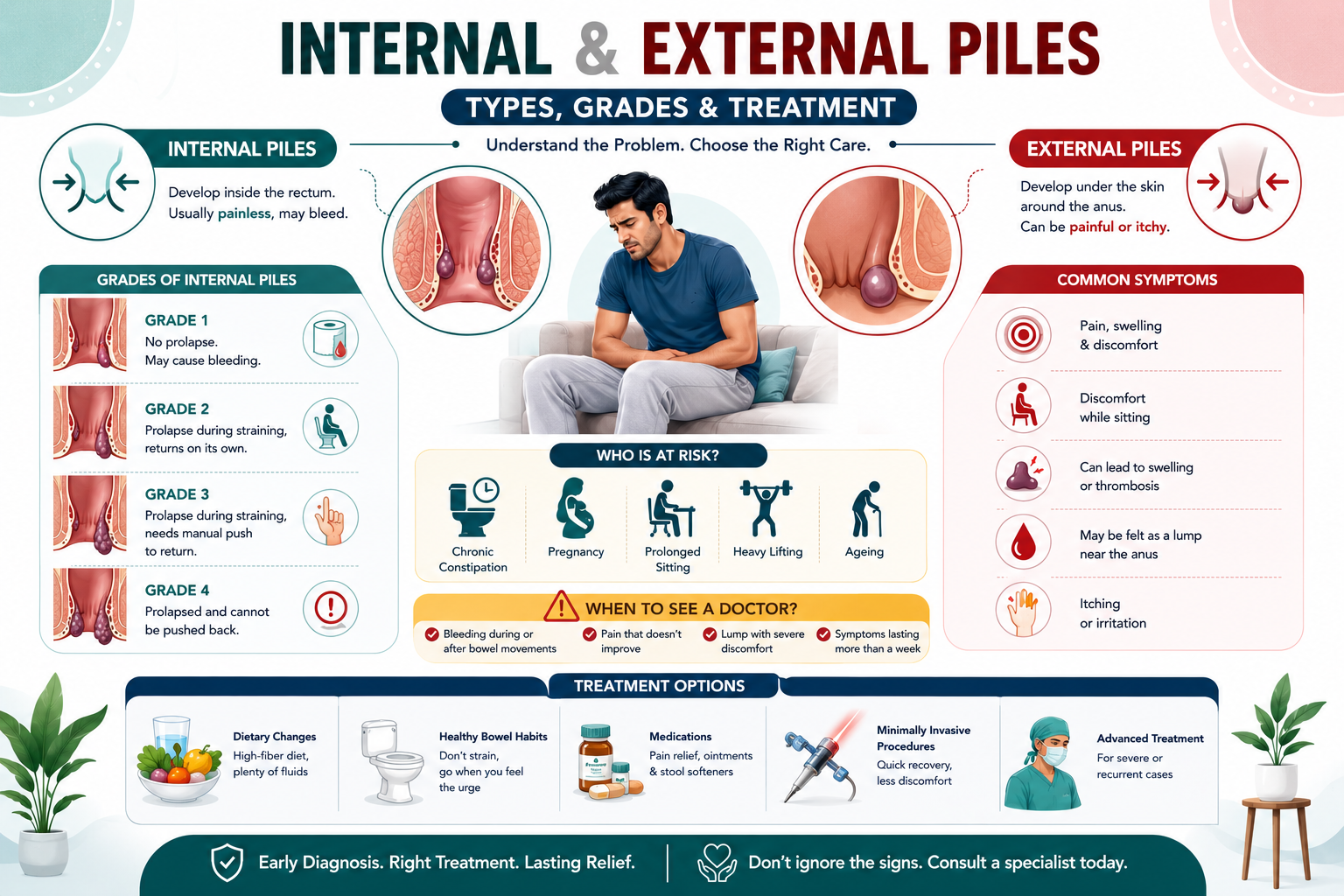
Piles are of two main types. Internal piles form inside the rectum, are usually painless, and mainly cause bright red bleeding. External piles form under the skin around the anus, and cause itching, a lump and pain, especially if a clot forms. Internal piles are graded 1 to 4 by how far they prolapse. Many people have both types together. Laser surgery can treat internal and external piles alike.
Knowing which type of piles you have explains your symptoms and points to the right treatment. This guide covers internal and external piles, how they differ, the four grades, which type is more painful, and how each is treated.
Internal Piles
Internal piles form inside the rectum, above the anal opening, in an area with very few pain nerves. That is why they are usually painless, and their main symptom is bright red bleeding during or after a bowel movement. As they enlarge, internal piles can prolapse, meaning they slip down through the anus, and this is what the grading system measures. Internal piles are the type most likely to cause the steady bleeding that, if heavy or ongoing, can lead to anaemia.
External Piles
External piles form under the skin around the anus, in an area rich in pain-sensitive nerves. Because of this, they cause itching, swelling, discomfort, and a soft lump you can feel at the anal edge. Their most painful complication is thrombosis, when a clot forms inside and creates a sudden, hard, painful lump. External piles can also leave a small skin tag once they settle. They are not graded the way internal piles are.
Internal vs External Piles: Side by Side
| Feature | Internal piles | External piles |
|---|---|---|
| Location | Inside the rectum, above the anal opening | Under the skin around the anus |
| Pain | Usually painless | Itchy and painful, especially if clotted |
| Main symptom | Bright red bleeding | Lump, itching, discomfort |
| Prolapse | Can prolapse, graded 1 to 4 | Does not prolapse |
| Thrombosis risk | Low | Can thrombose into a painful lump |
| Skin tag | No | May leave a skin tag |
The Four Grades of Piles
Grading applies to internal piles and is based on how far they prolapse. It decides the treatment.
| Grade | What happens | Usual treatment |
|---|---|---|
| Grade 1 | Stay inside, may bleed | Diet, fibre, lifestyle |
| Grade 2 | Prolapse on passing stool, return on their own | Diet plus banding if needed |
| Grade 3 | Prolapse and must be pushed back by hand | Laser surgery usually advised |
| Grade 4 | Permanently prolapsed, cannot be pushed back | Surgery required |
Can You Have Both Internal and External Piles?
Yes, and it is common. When both are present together it is called mixed or interno-external piles. You then get a combination of symptoms: painless bleeding from the internal part and a lump, itching or pain from the external part. The good news is that laser piles surgery can treat both components in a single stitchless procedure, so having both types does not mean two separate operations.
Treatment by Type and Grade
Both types begin with the same conservative care: a high-fibre diet, plenty of water, sitz baths and not straining. Beyond that, treatment depends on type and grade. Grade 1 and 2 internal piles may be banded. Grade 3 and 4 internal piles, and troublesome or thrombosed external piles, are best treated with a procedure. Laser piles surgery handles both internal and external piles as a day-care, stitchless treatment. See the full options and cost in our piles treatment and laser surgery guide. For conservative steps first, see our home remedies guide.
When to See a Doctor
Book a consultation if you have
- Bleeding that is persistent, heavy or keeps returning
- A pile that stays prolapsed and cannot be pushed back
- A sudden, hard, painful lump at the anus
- Symptoms of both types together that are not settling
- Any bleeding with a change in bowel habit, weight loss or new onset after age 40
Want to know your type and grade?
A quick examination with Dr. Deeraj Jaliwar at Vivekananda Hospital, Begumpet settles it. Consultation Rs. 750, OPD Monday to Saturday, 10 AM to 2 PM.
Frequently Asked Questions
What is the difference between internal and external piles?
Internal piles form inside the rectum, above the anal opening, where there are few pain nerves, so they are usually painless and their main sign is bright red bleeding. External piles form under the skin around the anus, where there are pain-sensitive nerves, so they cause itching, discomfort and a lump you can feel, and can become very painful if a clot forms. Internal piles are graded 1 to 4 by how far they prolapse, while external piles are not graded that way.
Are internal or external piles more painful?
External piles are generally more painful because they sit in skin that is rich in pain nerves, so they cause itching, aching and, if a clot forms, sharp pain. Internal piles are usually painless and show up mainly as bleeding, though a large internal pile that prolapses and gets trapped can also hurt. In short, bleeding without pain points to internal piles, while a painful lump points to external piles.
Which is worse, internal or external piles?
Neither is automatically worse; it depends on the grade and symptoms. Internal piles can be more serious in terms of bleeding, since heavy or ongoing bleeding can cause anaemia, and advanced grade 3 and 4 internal piles prolapse and need surgery. External piles are more troublesome for pain and thrombosis. Both are treatable, and laser surgery works for both types.
Can you have internal and external piles at the same time?
Yes, having both internal and external piles together is common, and it is called mixed or interno-external piles. When this happens you may notice a combination of symptoms: painless bleeding from the internal component and a lump, itching or discomfort from the external one. Laser piles surgery can treat both components in the same procedure.
What grade of piles needs surgery?
Grade 1 and grade 2 piles are usually managed with diet, lifestyle and, if needed, banding. Grade 3 piles, which prolapse and must be pushed back by hand, and grade 4 piles, which stay permanently prolapsed, typically need surgery, for which laser treatment is well suited. Painful thrombosed external piles may also need a procedure. The grade is confirmed by a quick clinic examination.
How are internal and external piles treated?
Both types start with the same conservative care: a high-fibre diet, water, sitz baths and avoiding straining. Internal piles at grade 1 to 2 may be banded, while grade 3 to 4 need a procedure. External piles are treated for symptoms, and thrombosed ones can have the clot removed early. When surgery is needed, laser piles surgery treats internal and external piles stitchlessly as a day-care procedure. Dr. Deeraj Jaliwar at Vivekananda Hospital, Begumpet advises after examination. Call +91 7207904418.
Medically reviewed by Dr. Deeraj Jaliwar, MS (General Surgery), DMAS, Vivekananda Hospital, Begumpet. Last updated July 2026. For educational purposes only. Always consult your doctor for personal medical advice. Not for medical emergencies; for urgent help call +91 7207904418.
If our content helps you, tell Google to show you more of it. Add vivekanandahospital.in as a preferred source.