
Dengue Test: NS1, IgM, IgG and When to Take Each
There are three main dengue tests, and timing decides which one works. The NS1 antigen test confirms dengue early, from day 1 to about day 5. The IgM antibody test picks it up from around day 4 to 5. IgG appears later and points to past or repeat infection. A CBC checks your platelets but does not confirm dengue on its own. The common mistake is testing too early for antibodies and getting a false negative. In Hyderabad, some people test negative despite clear symptoms, so a negative result with a strong fever needs a doctor's review.
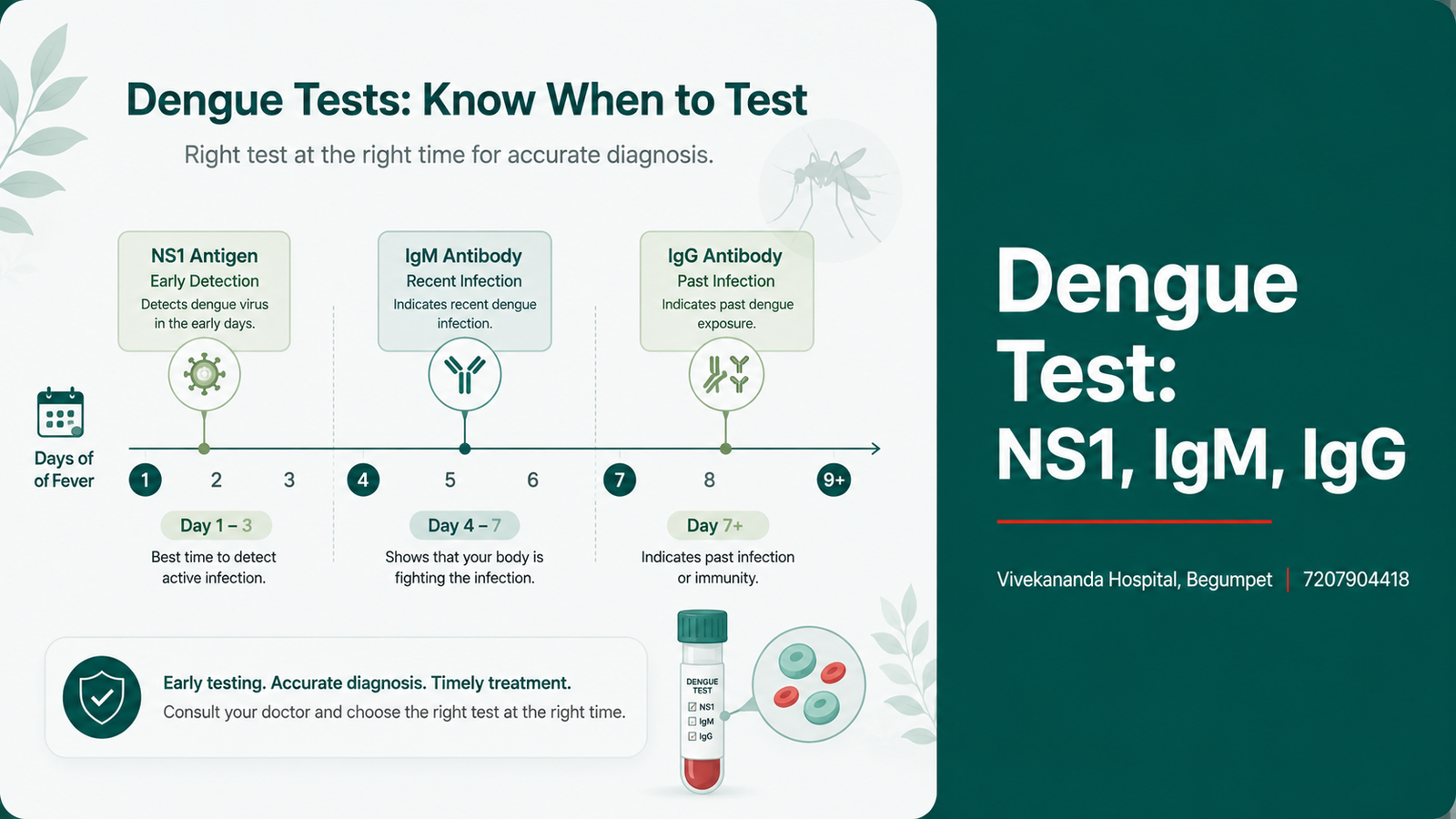
The right dengue test at the right time gives a clear answer; the wrong timing gives a false negative and false reassurance. This guide explains each test, when to take it, how to read the results, why tests come back negative despite symptoms, and the difference between rapid cards and lab ELISA. It is general information, not a diagnosis.
The Main Dengue Tests
Four blood tests do the work, and they are usually combined rather than used alone.
| Test | What it detects | Best used |
|---|---|---|
| NS1 antigen | A viral protein present early in infection | Day 1 to 5, confirms dengue early |
| IgM antibody | The body's early antibody response, recent infection | Day 4 to 5 onwards |
| IgG antibody | Later antibody, past or repeat (secondary) infection | From the second week, or high early in secondary infection |
| CBC (blood count) | Platelets, white cells, haematocrit | Throughout, to support and monitor, not to confirm |
When to Take Each Dengue Test
This is the part that trips people up. The virus and the antibodies appear at different times, so a test on the wrong day can read negative even when you have dengue.
| Day of fever | Best test |
|---|---|
| Day 1 to 3 | NS1 antigen (antibodies are not up yet) |
| Day 4 to 5 | NS1 plus IgM (overlap window, both can be positive) |
| Day 5 onwards | IgM, and IgG, as NS1 starts to fade |
The practical rule: test early with NS1. If you can only test on day 1 or 2, an antibody test alone may be falsely negative, so NS1 is the one to ask for, and a repeat a few days later may be needed if the fever continues.
NS1, IgM and IgG Explained Simply
NS1 is a piece of the virus itself, so a positive NS1 means the virus is present now. It is the earliest confirmation. IgM is the body's first wave of antibodies, so it signals a recent or current infection, appearing a few days in. IgG is the longer-lasting antibody; on its own it can just mean past infection, but a strongly positive IgG alongside IgM suggests a second dengue infection, which deserves closer watching because repeat infections can be more severe.
Why Is My Dengue Test Negative but I Have Symptoms?
This is common and worth understanding rather than dismissing.
- Tested too early. Antibodies had not appeared yet, so IgM was negative.
- Tested too late. NS1 had already cleared, so the early test missed the window.
- Rapid card limits. A quick card test is less sensitive than a lab ELISA and can miss cases.
- It is another viral fever. Several infections mimic dengue closely.
In Hyderabad this season, many people with classic dengue-like symptoms and falling platelets test negative and are treated as dengue-like viral fever. A negative test does not cancel your symptoms. If you have a persistent high fever or any warning signs, see a doctor, who may repeat the test, because the management and the danger signs are the same either way. See dengue symptoms and warning signs.
Rapid Card Test vs Lab ELISA
A rapid card test gives a result in minutes and is useful for a quick first check, but it is less accurate. A lab ELISA test is more sensitive and specific and is the more reliable confirmation, though it takes a little longer. When a rapid card is negative but the clinical picture strongly suggests dengue, a lab ELISA or a repeat test is often the right next step.
Cost and Availability
Dengue tests are widely available and relatively inexpensive, and NS1 with IgM is commonly done together. At Vivekananda Hospital the in-house lab gives fast NS1, IgM and CBC reports, so treatment is not delayed waiting on results. If you are admitted, testing is part of your cashless package under insurance and schemes. For treatment details, see dengue fever treatment in Hyderabad.
When to Get Tested
Get tested if a high fever lasts more than a day or two in dengue season, especially with severe body pain, headache or pain behind the eyes. Do not wait for a test to act on danger, though.
Do not wait for a test result if you have
- Bleeding from the gums or nose, or blood in vomit or stool
- Severe abdominal pain or persistent vomiting
- Breathlessness, drowsiness, cold clammy skin or very little urine
Go to the emergency department. Call +91 7207904418.
Need a dengue test done right?
Get the correct test at the correct time, with fast in-house reports. Consult Dr. Ravi Sishir Reddy at Vivekananda Hospital, Begumpet, and get a clear answer instead of guessing.
Frequently Asked Questions
Which test confirms dengue?
In the first few days the NS1 antigen test confirms dengue, and from around day 4 to 5 the IgM antibody test does. Often both are done together. A complete blood count showing falling platelets supports the diagnosis but does not confirm it on its own. ELISA-based tests are more reliable than rapid card tests.
When should I do a dengue test?
Timing decides accuracy. The NS1 test is most reliable in the first 1 to 5 days of fever. IgM antibodies appear around day 4 to 5, so an antibody test done on day 1 or 2 can be falsely negative. If you test very early, a repeat after a few days may be needed. Test when a high fever lasts beyond a day or two in dengue season.
What is the NS1 test?
NS1 is a protein made by the dengue virus that appears in the blood early in the infection. The NS1 antigen test detects it and can confirm dengue from day 1, which makes it the best early test. It becomes less reliable after about day 5 to 7 as the protein clears from the blood.
Why is my dengue test negative but I have symptoms?
Common reasons are that the test was done too early, before antibodies appear, or too late, after NS1 has cleared, that a rapid card test missed it, or that it is a different viral fever that mimics dengue. In Hyderabad many dengue-like fevers test negative. A negative test with strong symptoms should be reviewed by a doctor and sometimes repeated, and the warning signs and management stay the same either way.
What is the difference between IgM and IgG in dengue?
IgM antibodies appear first, around day 4 to 5, and indicate a recent or current infection. IgG appears later and can stay for months to years. A high IgG together with IgM can point to a second, or secondary, dengue infection, which can be more severe. A doctor reads IgM and IgG together with the NS1 result.
Is a CBC enough to diagnose dengue?
No. A complete blood count showing low platelets, low white cells and a rising haematocrit strongly supports dengue and is essential for monitoring, but it does not confirm it. Confirmation needs the NS1 antigen or antibody test. In practice a CBC and NS1 or IgM are usually done together.
Reviewed by Dr. Ravi Sishir Reddy, MD (General Medicine), Vivekananda Hospital, Begumpet. Last updated 12 Aug 2026. For general information only and not a substitute for medical advice or diagnosis. Do not delay care for warning signs while waiting on a test. Not for medical emergencies; for urgent help call +91 7207904418.
If our content helps you, tell Google to show you more of it. Add vivekanandahospital.in as a preferred source.