
Widal Test for Typhoid: Normal Range, Results and Accuracy
The Widal test is a blood test that checks for antibodies against the typhoid bacterium, reported as titres like 1:80 or 1:160. It supports a typhoid diagnosis but does not confirm it alone. Timing matters, it is most useful after the first week of fever, and it can read falsely positive or negative, so a single result is never enough. A blood culture is the more definitive test. The number on your report means little without a doctor reading it against your symptoms. Call +91 7207904418 to have yours interpreted.
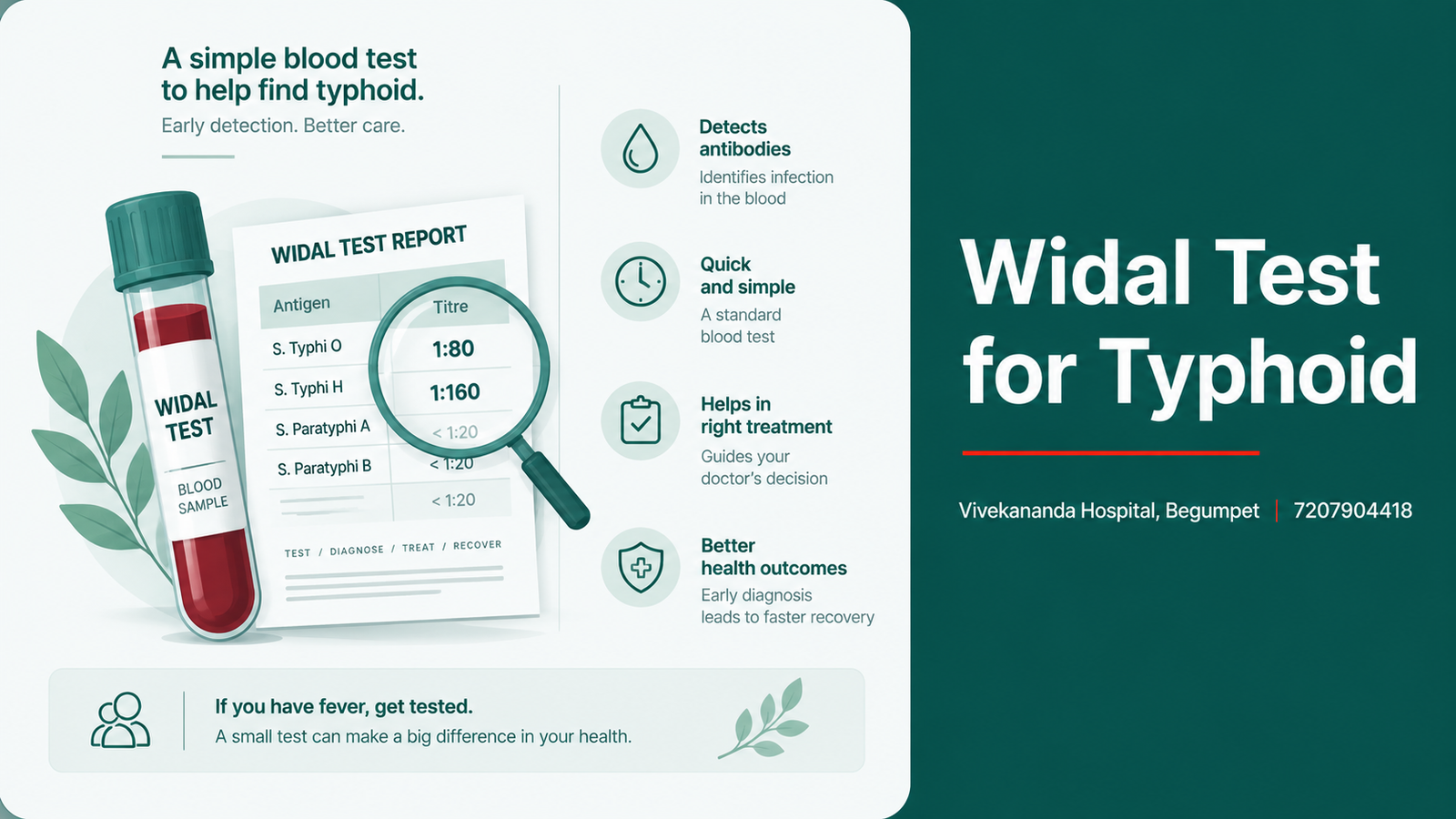
What Is the Widal Test?
The Widal test is a blood test that detects antibodies your immune system produces against Salmonella Typhi, the bacterium that causes typhoid. It measures two antibodies: O, made against the body of the bacterium, and H, made against its tail. Results are reported as titres, a ratio such as 1:40, 1:80 or 1:160, showing how much your blood can be diluted and still react. It is a supportive test, meaning it adds evidence toward typhoid but does not confirm it by itself.
Widal Test Normal Range and Titres
There is no single fixed normal range that applies everywhere, and this is the most misunderstood part of the report. Titres are read against your lab's own reference and against how common typhoid exposure is in your area.
| Titre | General interpretation |
|---|---|
| 1:20 to 1:80 | Often not significant on their own, common from past exposure or vaccination |
| 1:160 | May be significant, especially with typical symptoms |
| 1:320 and above | More strongly suggestive of active typhoid |
| Fourfold rise | A rise across paired samples 1 to 2 weeks apart is the most reliable sign |
How Widal Results Are Read
A doctor does not read the O and H titres in isolation. What matters is the height of the titre, whether it fits the illness, how many days you have had fever, and ideally whether the titre is rising. A single moderately raised titre in someone with a few days of fever means far less than a high or rising titre in someone with a week of typical symptoms. The report is one input; your clinical picture is the rest.
Accuracy and Limitations
The Widal test is widely used because it is quick and inexpensive, but it has real limitations you should know.
- False positives. A previous typhoid infection, typhoid vaccination, or other infections can raise titres without current typhoid.
- False negatives. Done in the first few days of fever, before antibodies rise, it can miss active typhoid. Prior antibiotics can also lower the response.
- Endemic background. In areas where typhoid is common, baseline titres are higher, which blurs the line between significant and not.
- Single sample. One test is much weaker than paired samples showing a rising titre.
When to Take the Widal Test
The Widal test is most useful after about the first week of fever, once antibodies have had time to develop. Taken too early it is often falsely negative. If typhoid is suspected in the first few days, a blood culture is the better choice because it can find the bacteria before antibodies appear.
Widal Test Versus Blood Culture
| Feature | Widal test | Blood culture |
|---|---|---|
| What it finds | Antibodies to the bacterium | The bacterium itself |
| Reliability | Supportive, can mislead | Most definitive |
| Best timing | After the first week | First week of fever |
| Speed and cost | Fast, inexpensive | Takes days, costs more |
The two are complementary. Culture confirms, Widal supports, and a doctor decides which is needed based on how long you have been ill.
Get your Widal report interpreted properly
A titre number is not a diagnosis. Have it read against your symptoms by Dr. Ravi Sishir Reddy at Vivekananda Hospital, Begumpet, with in-house lab support and blood culture when needed.
Frequently Asked Questions
What is the Widal test?
The Widal test is a blood test that looks for antibodies your body makes against the typhoid bacterium, Salmonella Typhi. It measures two antibodies, called O and H, and reports them as titres such as 1:80 or 1:160. It supports a typhoid diagnosis but does not confirm it on its own; a doctor reads it alongside your symptoms and, when needed, a blood culture.
What is the normal range for the Widal test?
Results are reported as titres like 1:20, 1:40, 1:80 or 1:160. Low titres such as 1:20 to 1:80 are often not significant, especially in areas like India where past exposure is common, while 1:160 or higher may be significant. Cut-offs vary between labs, so the normal range depends on your lab's reference and must be read by a doctor, not compared to a fixed number.
Is the Widal test enough to confirm typhoid?
No. The Widal test supports a diagnosis but is not definitive on its own. It can be falsely positive from past infection, vaccination or other illnesses, and falsely negative if done too early. A blood culture is the more definitive test, and your doctor combines the result with your symptoms to decide.
When should the Widal test be done?
The Widal test is most useful after about the first week of fever, once antibodies have had time to rise. Done in the first few days it can be falsely negative. If typhoid is suspected early, a blood culture is preferred because it can detect the bacteria sooner.
What is the difference between the Widal test and a blood culture?
A blood culture grows the bacteria from your blood and is the most definitive typhoid test, best in the first week. The Widal test only detects antibodies and is supportive, useful later in the illness. Culture is more specific; Widal is quicker and cheaper but less reliable on its own.
Can the Widal test be falsely positive?
Yes. A Widal test can read positive from a previous typhoid infection, from typhoid vaccination, or from other infections, and baseline titres are often higher in endemic areas. This is why a single raised titre is not enough, and a doctor interprets it with your symptoms or confirms with a rising titre or a blood culture.
Reviewed by Dr. Ravi Sishir Reddy, MD (General Medicine), Vivekananda Hospital, Begumpet. Last updated 14 Aug 2026. For general information only and not a substitute for medical advice or diagnosis. Do not interpret a Widal titre yourself or start treatment based on it; have it assessed by a doctor. Not for medical emergencies; for urgent help call +91 7207904418.
If our content helps you, tell Google to show you more of it. Add vivekanandahospital.in as a preferred source.